
Why custom software fails when people don’t use it
Custom software is designed to solve specific business problems, adapt to internal processes, and create a competitive advantage.
Yet many companies face the same issue:
the software exists, it works… but no one actually uses it.
Low user adoption leads to:
- underutilized investments;
- processes that remain manual;
- incomplete or unreliable data;
- internal resistance to change.
In questo articolo vediamo come potenziare la user adoption nei software custom, e perché tecnologia, dati e persone devono lavorare insieme.
What is user adoption (and why it matters)
User adoption measures how effectively a software solution is used by its intended users.
It’s not just about:
- how many people log in;
- how often they use the system.
It’s about:
- whether they use it correctly;
- whether they find it useful;
- whether it becomes part of their daily workflow.
A custom software solution succeeds only when it becomes a natural part of business operations.
Why user adoption is often low in custom software
Built around processes, not users. Many custom solutions are designed around business processes rather than user experience.
The result:
- complex interfaces;
- unintuitive workflows;
- excessive or unnecessary features.
If users have to “think too much,” they will stop using the system.
Lack of integration with existing tools
Custom software that doesn’t integrate with:
- CRM,
- ERP systems,
- marketing tools,
- legacy systems,
forces users to duplicate tasks and data. This is one of the biggest barriers to adoption.
Incomplete or unreliable data
If the data inside the system is:
- outdated,
- inconsistent,
- not valuable,
users lose trust and revert to tools like spreadsheets.
Key strategies to Iiprove user adoption
1. Design for users, not just requirements
Effective custom software starts with:
- role analysis;
- understanding daily workflows;
- mapping real pain points.
UX and UI are not optional, they are strategic drivers of adoption.
2. Integrate into the business ecosystem
The more isolated a system is, the less it will be used.
Custom software should:
- integrate with CRM systems;
- share data across platforms;
- act as a single source of truth.
Users should see it as their operational hub, not an extra tool.
3. Make data work for the user
Software should deliver immediate value through data:
- clear dashboards;
- actionable insights;
- automations that simplify tasks.
When users see tangible benefits, adoption grows naturally.
4. Continuous and contextual training
Training is not a one-time event. To increase adoption, companies need:
- guided onboarding;
- micro-learning experiences;
- in-app support.
The goal is to reduce friction and increase user confidence.
5. Continuous software evolution
Custom software is never “finished.”
To maintain high adoption:
- collect user feedback;
- monitor real usage;
- continuously improve workflows and features.
Adoption increases when software evolves with its users.
The role of custom software in a data-driven strategy
When user adoption is high, custom software becomes:
- a reliable data source;
- a process accelerator;
- a foundation for automation and AI.
Without adoption, it becomes just another technology cost.
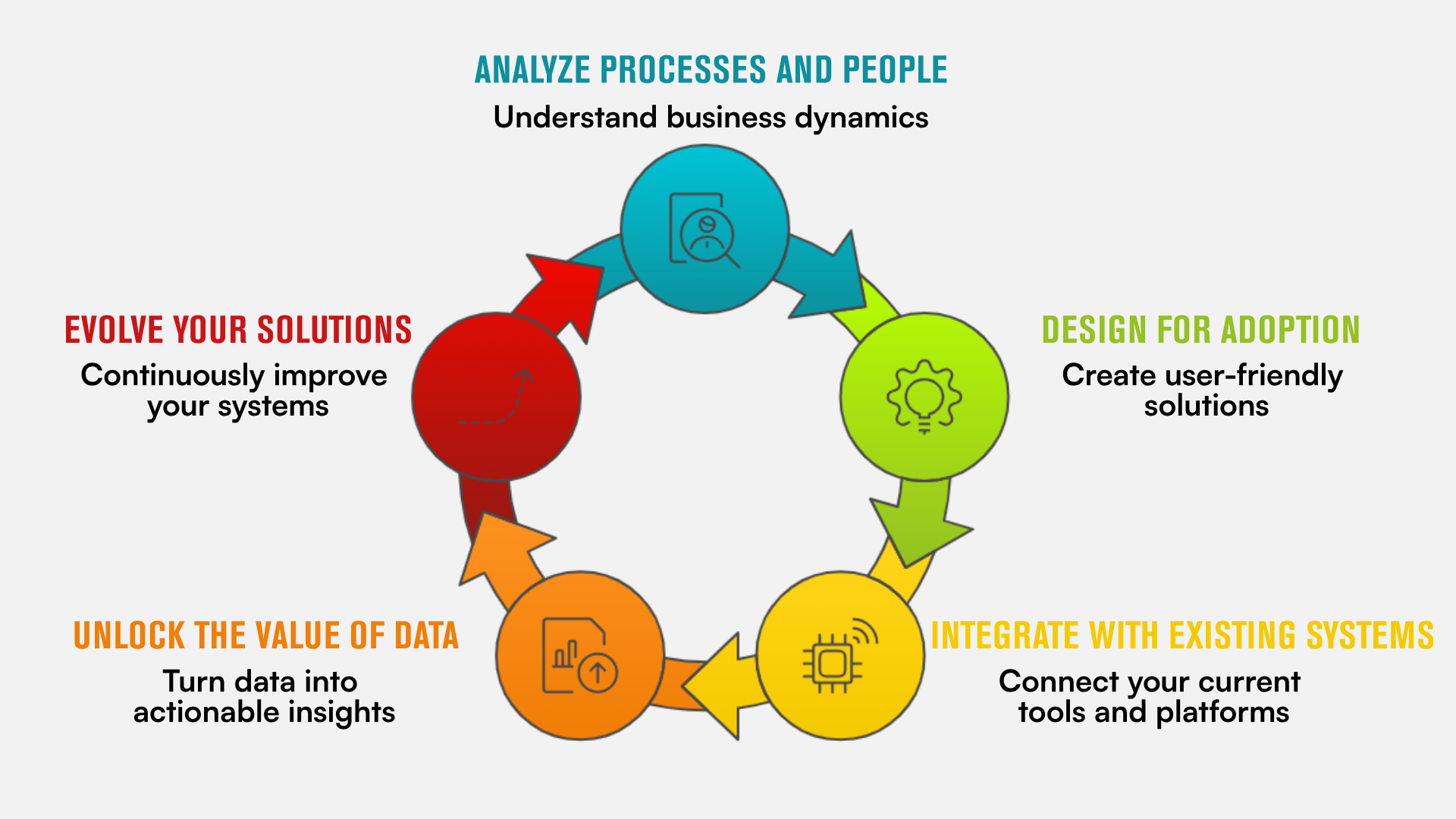
Our approach
We design custom software built to be used, not just delivered.
Our approach focuses on:
- aligning processes and people;
- adoption-driven design;
- seamless integration with CRM and existing systems;
- data optimization;
- continuous improvement.
Because software only creates value when people actually use it.
Do you have a custom software solution that isn’t being fully used?
Or are you planning to develop one? Let’s talk.
We help businesses design tailored solutions that people truly want to use.