
Business process digitalization means rethinking how activities are carried out, how information is collected and shared, and how people collaborate within a company.
For an SME, digitalizing business processes primarily means reducing manual activities, eliminating inefficiencies, connecting systems, and making data truly usable to support better business decisions.
The topic is becoming increasingly important in Italy. According to Unioncamere, the digital maturity of Italian businesses has increased by 8% since 2019.
What does business process digitalization mean?
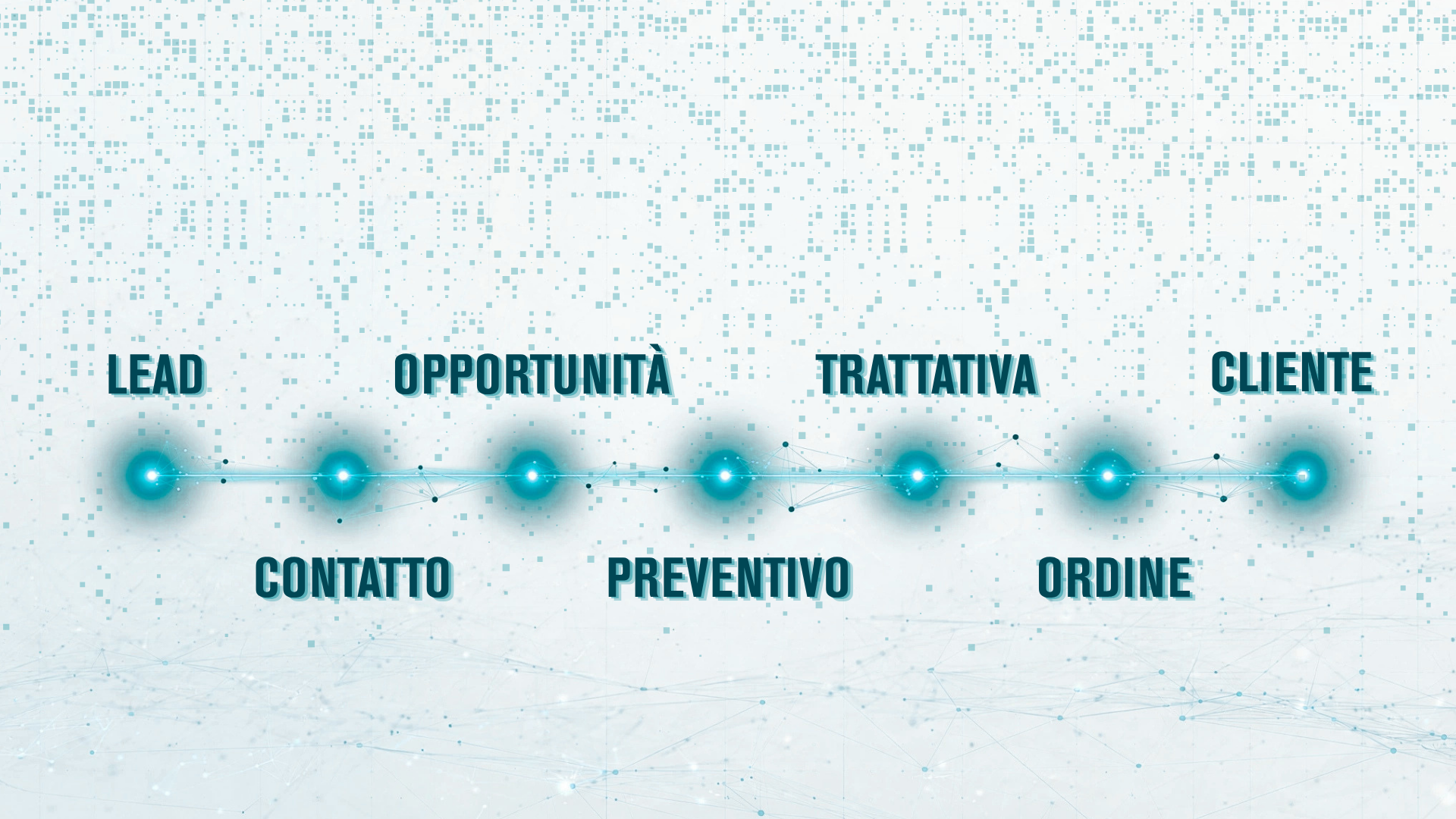
Let’s take the sales process as an example:
lead → contact → opportunity → quotation → negotiation → order → customer
If each stage is managed using different tools (Excel, emails, documents, and applications that do not communicate with each other) information can easily become fragmented.
This is where digitalization comes in. It allows companies to turn a fragmented process into a structured, traceable and, where possible, automated workflow.
The result is a more connected digital environment where software systems can actually work together, making everyday activities simpler and more efficient.
Why is digitalization important for SMEs?
SMEs often share a common characteristic: their processes have grown alongside the business.
A procedure that initially worked well with a simple Excel spreadsheet can become much more complex as the number of customers, employees, orders and information increases.
Digitalization helps companies build an organization that is more integrated, measurable and scalable.
Data from companies in the Veneto region also show an increasingly strong relationship between digital transformation, innovation and competitiveness.
According to Unioncamere del Veneto, in 2025 around 54% of the surveyed companies had adopted digital technologies. The percentage rose to 67.2% among exporting companies.
Which business processes can be digitalized?
Almost any business process can potentially be analyzed and improved through digital technologies.
1. Sales processes and customer management
2. Quotation and order management
3. Marketing and lead management
4. Document management
5. Customer support and after-sales service
Digitalization does not mean automating everything
A common mistake is to think that digitalizing a process simply means automating it.
In reality, automating an inefficient process can make the inefficiency even faster.
Before introducing a new technology, it is therefore essential to analyze the existing process:
How does it work today?
Who is involved?
Which information is being used?
Where do bottlenecks occur?
Which activities are repeated?
Which data is entered multiple times?
Which steps could be eliminated or simplified?
Only after this analysis does it make sense to choose the most suitable technology.
The role of System Integration
As a company grows, it rarely relies on a single software platform to manage everything.
CRM, ERP, accounting software, marketing platforms, portals, custom applications and communication tools can all be necessary.
The problem arises when these systems cannot communicate with each other.
This is where System Integration becomes essential.
Integrating systems means enabling different applications to exchange data and information, creating a consistent and connected digital ecosystem.
For example:
Website → CRM → ERP → Administration → Customer Service
When systems are integrated, information can follow the customer throughout the entire business process without having to be manually entered again at every stage.
Which processes should your company digitalize?
At WSB Group, we support companies in their digital transformation not simply by introducing new technologies, but by understanding how the organization works, which systems are already in place and how they can be connected.
We combine CRM, software, custom applications and digital solutions to build technology ecosystems that are consistent with each company’s processes and business needs.
If you are evaluating a business process digitalization project, the first step can be to map your current processes and identify where technology can generate the greatest value. Contact us to discuss your digital transformation project.